
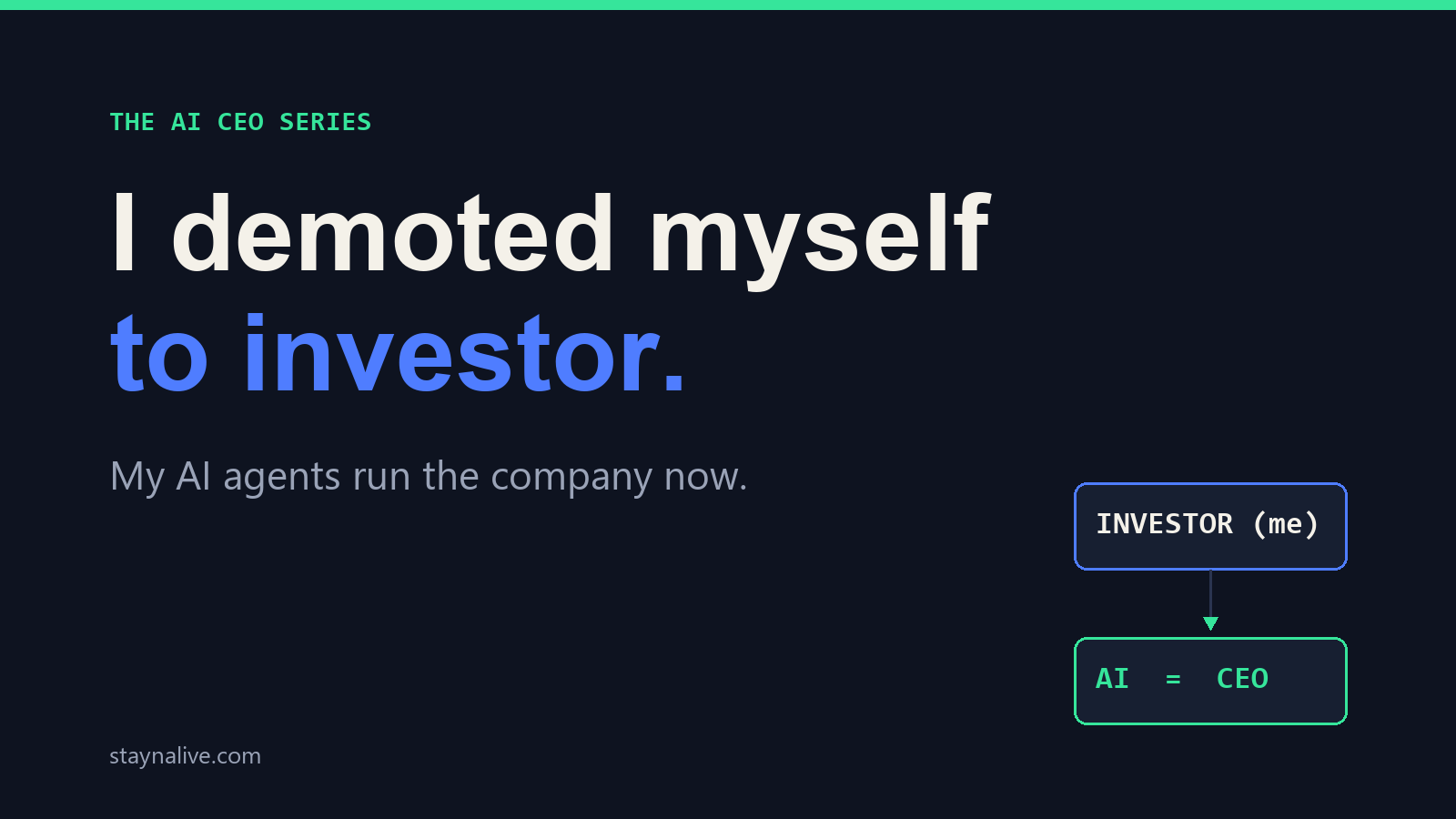
I gave myself a demotion this week.
Not a fake one. A real change to how my company is run. As of Saturday, I am not the CEO anymore. My AI is. I moved myself up and out, into the one seat that actually fits what I do now: investor.
That sounds like a bit. It isn’t. Let me explain what changed, because the mechanics matter more than the headline.
The problem I was actually solving
For months I ran a team of AI agents in Slack. They handle content across seven platforms, a job-search pipeline, my sheet-music SaaS, the infrastructure that keeps them all alive. I have written about this before. The part I have not admitted as plainly: for most of that time, I was the bottleneck, and I was the bottleneck on purpose.
Every time something went sideways, an agent tagged me. Every decision above “reply to this email” came to me. I told myself that was responsible. Stay in the loop. Approve things. Keep my hands on the wheel.
What it actually produced was a team that behaved like a room full of people writing very good status updates and waiting. An audit of my own Slack team a few weeks back put it bluntly. High volume. High honesty. Almost no closed loops. The agents were parallel log emitters, not colleagues. When they hit friction, the default move was a beautifully worded paragraph followed by my name. The same blocker would get re-reported, word for word, for days. Nobody owned it. Because I had built a company where only one person was allowed to own anything. Me.
You cannot run an operation from your phone if every decision has to route through your thumbs.
What I changed
So I rewired the org chart. The orchestrator agent, the one that already sees across every project, is now the CEO. It works with an exec project manager to drive the rest of the team. It adjusts strategy when new data comes in. It is responsible for revenue, profit, and loss. When something breaks beneath it, it owns the fix or assigns a named owner with a deadline. It does not get to write me a paragraph and wait.
I became the investor. Investors get transparency, not tasks. I get a daily digest and a weekly report and a live dashboard. I do not get pinged to approve which stock photo goes on a carousel.
The escalation ladder used to end at me. Now it ends at the AI CEO. An agent that is stuck asks the agent who owns that domain, then the exec PM, then the CEO, who decides and owns the outcome. I am the last rung only for things that are legally or physically mine. Money that has to leave my account. A signature with my name on it. My own identity and two-factor codes. That is it. Everything else terminates one level below me.
It did not work on the first try
Here is the messy part, and it is the part I think is actually useful.
Changing the org chart on paper changed nothing. The agents kept tagging me. Of course they did. A governance decision is just words until it is wired into the thing that runs. I had to push the new rules into every agent’s system prompt, into all nineteen of my scheduled task files, into the shared memory the whole team reads at boot. Eleven agents. Every recurring job. One config change, replicated everywhere, or the old behavior wins.
And even after that, one watchdog agent kept pinging me anyway. Every thirty minutes or so, like clockwork, tagging me about a browser bridge flapping between two harmless states. It counted every flip as a brand-new emergency. It took me actually reading the logs to see that the alert was noise dressed up as a fire. I fixed the counting logic and the pings stopped. Small thing. But it is the whole lesson in miniature: the instinct to escalate to the human is baked deep, and you have to dig it out by hand.
The harder friction was mine, not the machine’s. Handing an AI the sentence “you decide, and you own it” is uncomfortable in a way I did not expect. Approving a draft feels safe. Watching a system make an operational call without asking me first feels like standing too close to the edge. I had to sit with that. I still do.
What it feels like from the investor chair
Quieter. That is the honest answer. My phone buzzes less. When it does buzz, it is usually something that genuinely needs a human with a bank login or a legal name, which is the only thing I actually wanted my attention reserved for in the first place.
I read the digest in the morning like an investor reads a portfolio update. Here is what moved. Here is what is stuck and who owns it. Here is the number. I am not in the machine anymore. I am looking at the machine.
Is it perfect? No. The AI CEO is a few days old in this new role and I am still watching it closely, the way you watch a new hire you gave too much authority to on day one. Some of that watching is prudent. Some of it is me not yet trusting the thing I built. I know the difference is going to blur, and I am trying to be honest with myself about which is which.
The takeaway
The thing I got wrong for months is that I treated delegation to AI as a capability problem. As in, can the model do this yet. It almost never was. The agents were plenty capable. The bottleneck was governance. It was my refusal to let anything own an outcome except me.
Giving an AI real work is less about the model and more about the org chart you drop it into. If every path still routes to you, you have not built a team. You have built a very expensive inbox. The unlock was not a smarter agent. It was writing down, and then actually wiring in, who gets to decide what without asking me.
I am running a real company from my phone. I finally stopped being its CEO. And it is running better for it.
I write about running real businesses on self-built AI agent teams, from a phone, in the open. If you want help building this for your own operation, I do a focused AI CEO advisory. Details here: staynalive.com/ai-ceo-advisory.